
TurboSquid CheckMate™
Building a scalable quality system for a global 3D marketplace
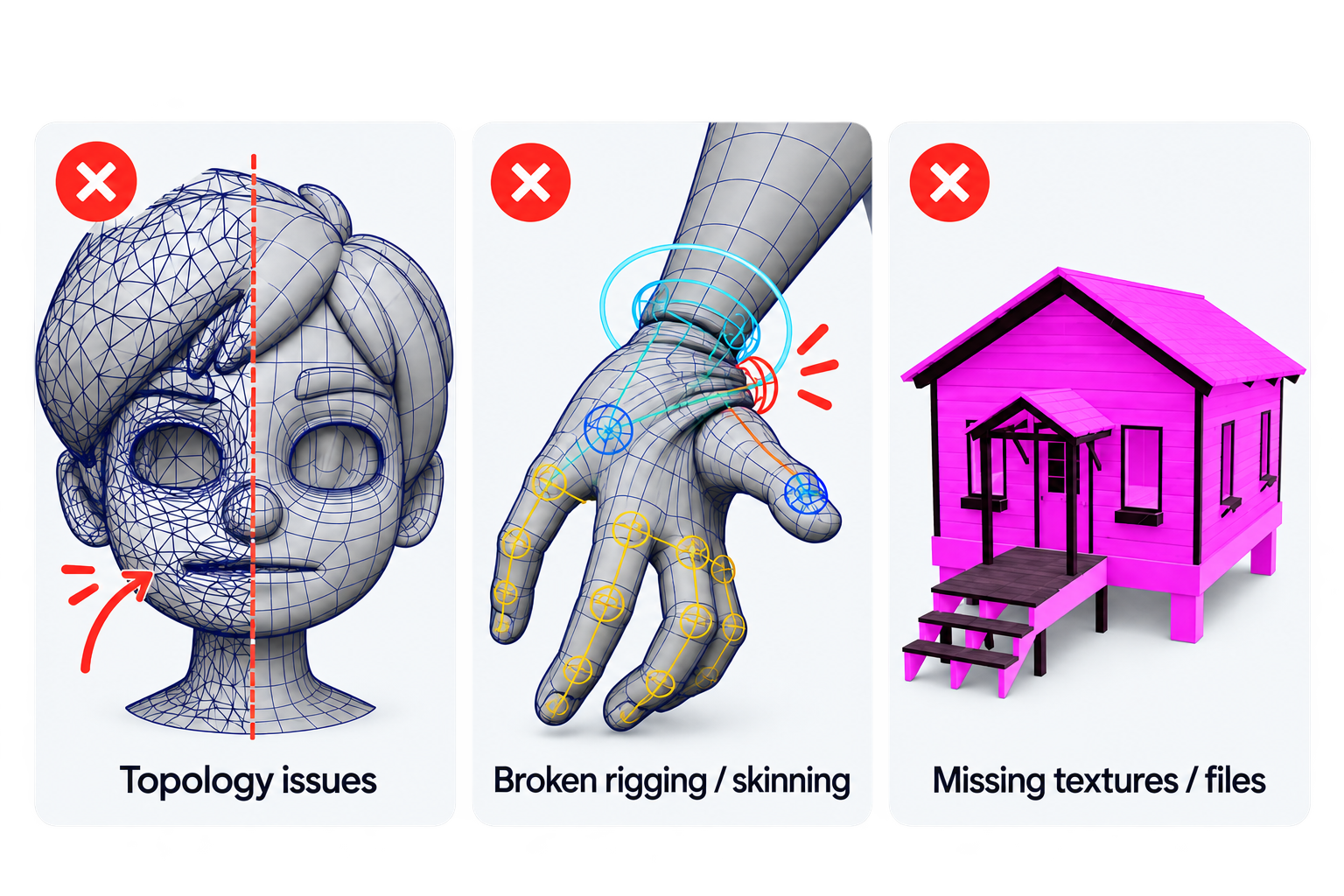
While working at TurboSquid, I began in customer support, where I regularly opened customer files, diagnosed problems, repaired assets, and returned them ready for use. Over time, I noticed the same quality issues appearing again and again across marketplace uploads: missing files, inconsistent naming, problematic scene structure, topology issues, and other technical defects that created friction for both buyers and support teams.
Rather than treating each issue as an isolated problem, I began documenting recurring patterns and translating them into measurable quality standards that could be applied more consistently across the marketplace.
That work contributed to the development of CheckMate™, TurboSquid’s asset certification program, combining defined production standards, validation criteria, artist education, and marketplace quality control. My role focused on identifying recurring problems, defining technical requirements, and helping translate those standards into a scalable system.
Role:
3D Quality Systems • Production Standards • Workflow Design • Engineering Collaboration • Artist Education • Customer Service
Tools / Skills:
3D Production • Technical QA • Validation Rules • Documentation • Training • Marketplace Systems • Video Production • Maya/3DsMax/C4D Pipelines
01 — The Problem
Quality was heavily dependent on the user uploading the work
TurboSquid’s marketplace contained work from thousands of independent artists, all using different tools, workflows, naming conventions, and production standards.
Many of the same issues surfaced repeatedly: missing textures or supporting files, inconsistent scene organization, geometry problems, incorrect naming, and assets that technically uploaded but were difficult for customers to use.
Manual review could catch individual problems, but it didn’t address the larger issue.
There needed to be a shared definition of what a production-ready 3D asset actually was.
02 — Finding the Patterns
Turning recurring problems into standards
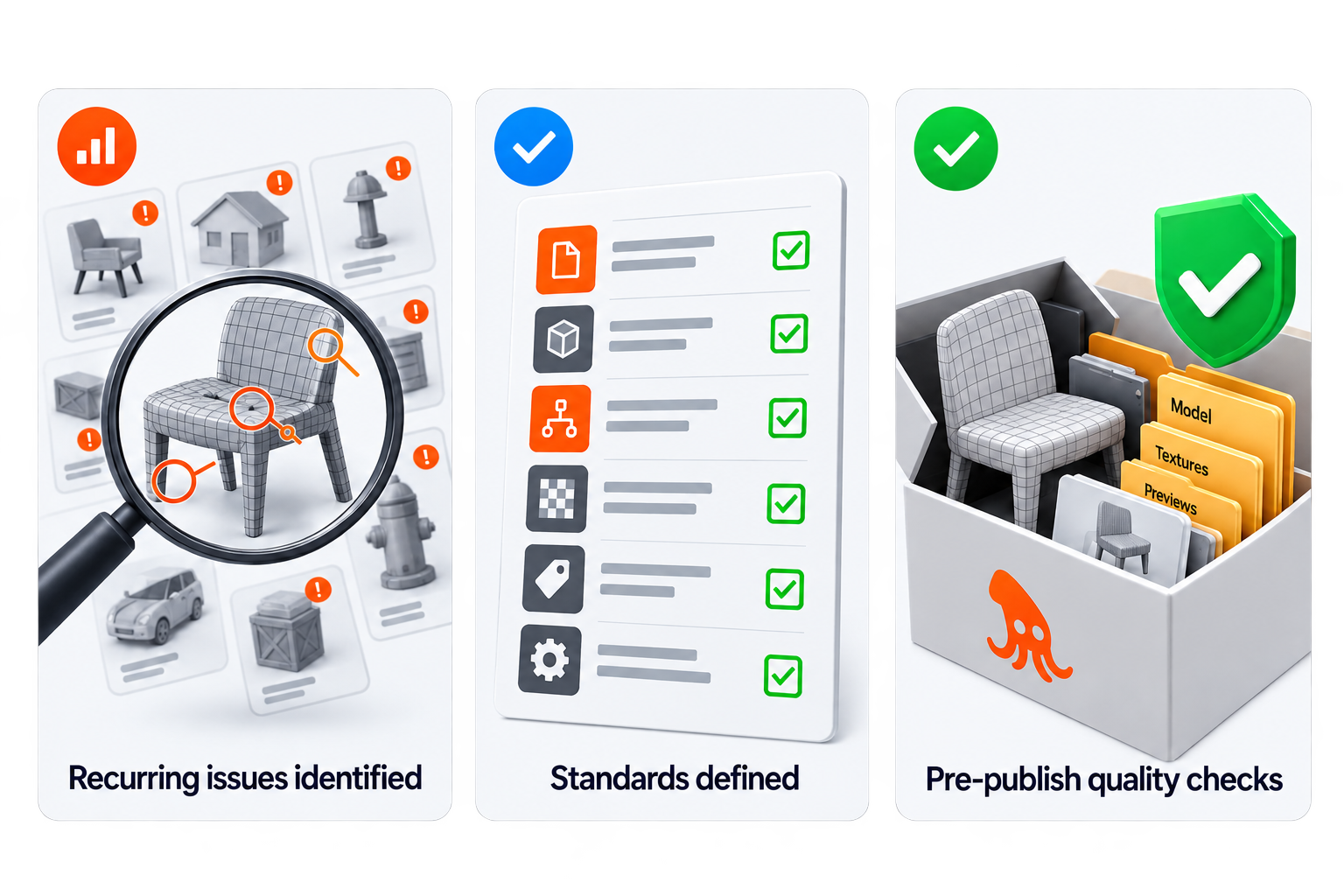
Because I was regularly reviewing assets and interacting with customers and artists, I had visibility into which defects appeared most often and which ones created the greatest downstream problems.
I began identifying recurring failure points and translating them into specific acceptance criteria.
Instead of saying an asset should simply be “high quality,” the standards could describe measurable requirements around things such as:
- required files and dependencies
- naming and organization
- geometry and scene structure
- technical cleanliness
- asset completeness
- usability after download
This turned subjective quality review into something much more systematic.
03 — From Standards to Validation
Designing rules that software could understand
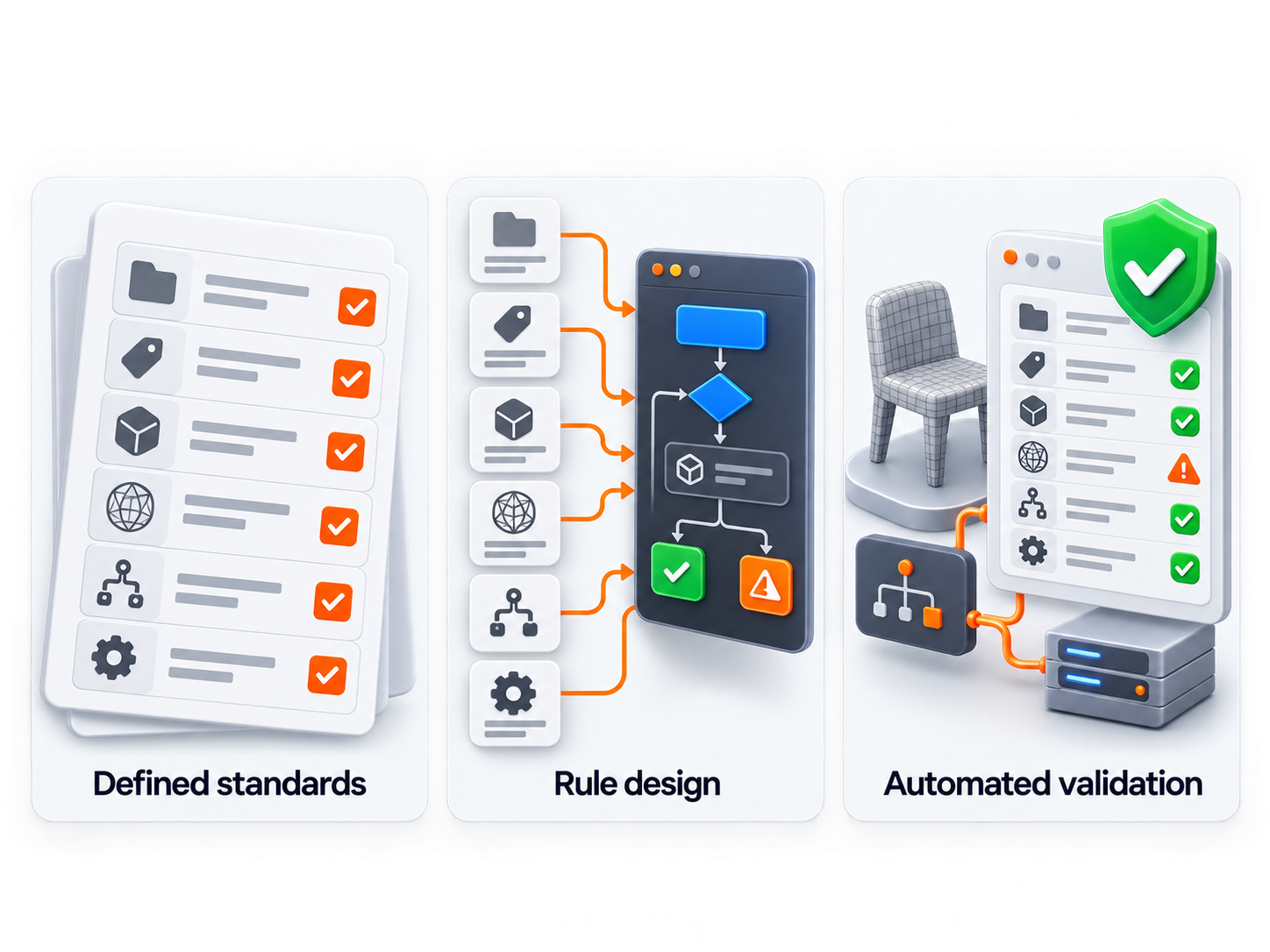
Once the quality requirements were defined clearly enough, they could begin informing automated validation.
I worked with engineering to communicate the production logic behind the checks: what should be tested, what constituted an error, and which issues should prevent an asset from passing certification.
Engineering translated those requirements into the technical validation and uploader workflow.
My role sat between the artists using the marketplace and the engineers building the system, helping convert real-world production problems into rules software could evaluate consistently.
Good automation starts with good rules.
04 — Building CheckMate™
Creating a marketplace quality signal
The resulting CheckMate system gave TurboSquid a structured way to identify assets that met defined technical and production standards.
Rather than buyers having to judge quality entirely from thumbnails and seller descriptions, certification provided an additional signal that an asset had passed a more rigorous set of checks.
For artists, the standards also made expectations clearer before submission.
The system helped shift quality control from a reactive support function toward a repeatable part of the marketplace itself.
05 — Education Was Part of the System
Helping artists succeed before validation
Automation alone wasn’t enough.
I created documentation and tutorial material explaining common production issues, why they mattered, and how artists could prepare their assets to meet the standards.
Working with the community team, we helped communicate those expectations back to marketplace contributors.
This reduced ambiguity for artists while reinforcing the idea that quality standards were not arbitrary restrictions, but practical guidelines designed to make assets more reliable for customers.

06 — The Broader Impact
From individual reviews to a scalable quality framework
What started as recurring observations during asset review became a much broader production-quality framework.
The work helped establish:
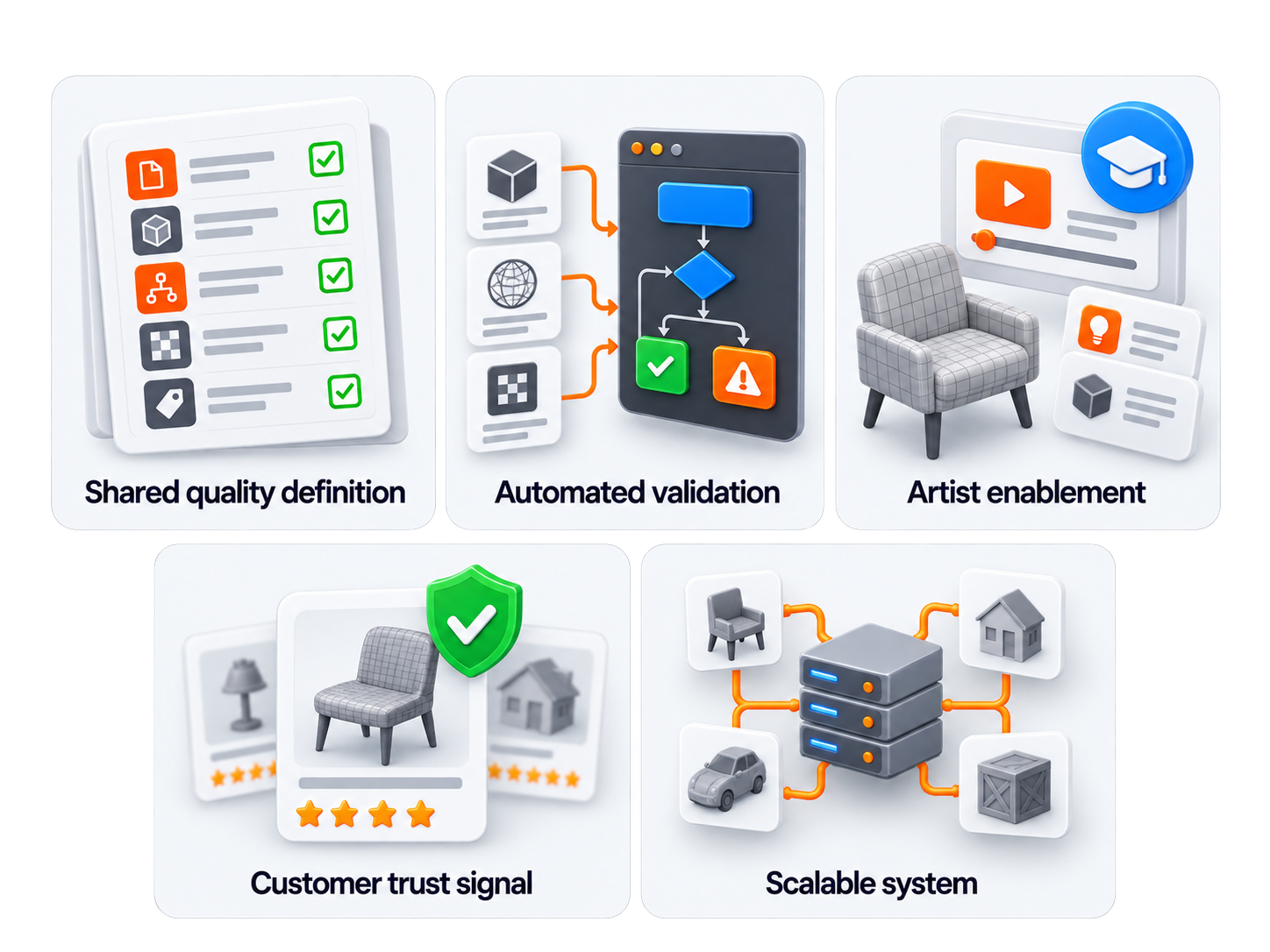
A shared definition of marketplace quality
Clearer technical expectations for sellers and reviewers.
Automated validation
Rules that could catch common problems before they reached customers.
Artist enablement
Tutorials and documentation that helped contributors improve their own workflows.
A stronger customer signal
Certification that helped distinguish assets meeting higher production standards.
A scalable system
Quality control that could operate beyond individual manual reviews.
My role was not simply identifying bad assets.
It was recognizing the patterns behind those problems, defining standards people could understand, and working with engineering to turn those standards into a system that could scale.