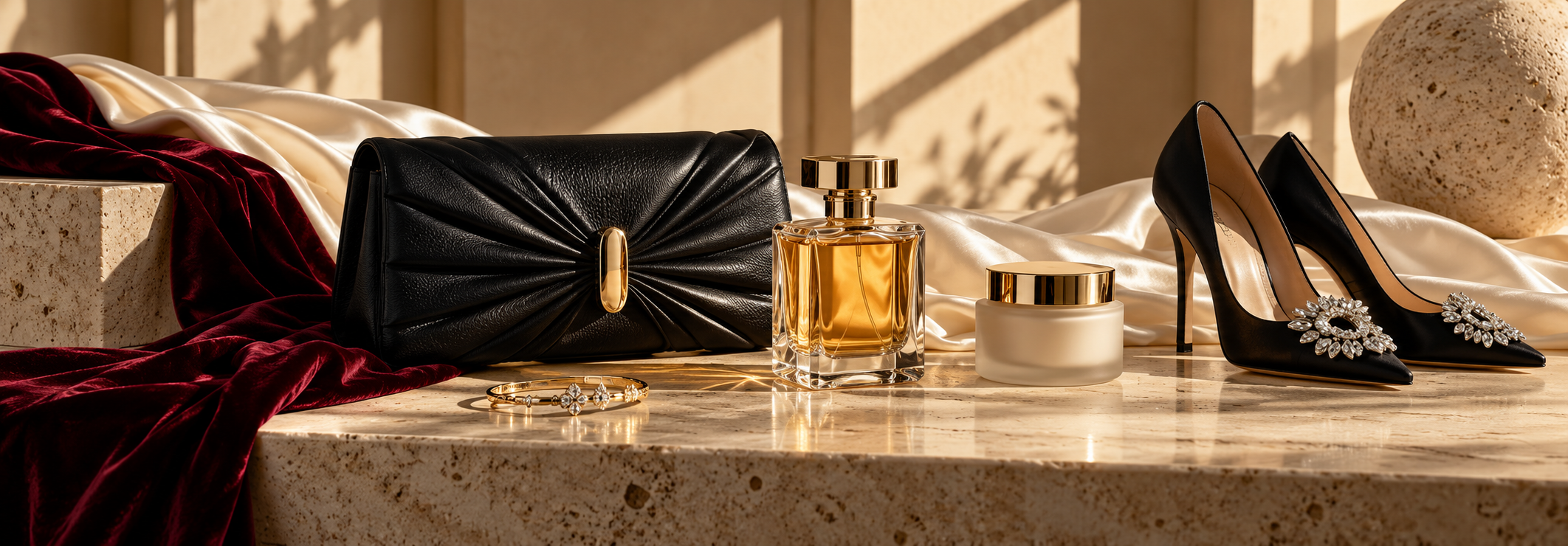
Amazon Luxury + Premium Beauty — Generative Commerce Imagery
Developing a reference-driven AI workflow for scalable, brand-accurate campaign production.
I developed campaign imagery for Amazon Luxury and Premium across web, email, social, push notifications, collections, and discovery experiences. Much of the work involved brands with limited usable assets, requiring us to create elevated lifestyle imagery while maintaining product scale, materials, labeling, and brand accuracy.
Role:
Visual development, GenAI workflows, image compositing, retouching, campaign production, Kiro/Figma prototyping
Tools:
Photoshop, Figma, GenAI tools, internal Amazon tools, custom prototype tools
The problem wasn’t generating a beautiful scene.
It was generating a beautiful scene without losing the product.
01 — The Challenge
Our clients often supplied only a handful of product photographs rather than comprehensive photography, dimensional references, or physical samples. Yet the generated imagery still needed to represent products accurately enough for customer-facing campaigns.
Early GenAI workflows relied heavily on text prompting: describe the scene, describe the product, and ask the model to produce both at once. The results were visually appealing but unreliable. Product scale drifted, labels changed, packaging proportions shifted, materials became inaccurate, and small details were frequently hallucinated.
We were getting tired of photo editing, and only a few people on our team were honestly good at it. At least for the level we needed.We also wanted very, very specific backgrounds for our work that current AI models were unable to give us. It was a give or take. Either we had a beautiful background and a horrible product render, or vice versa. Something needed to shift quickly.
For luxury and premium products, those errors and obstacles mattered.
02 — What I did: Reference-Driven Generation (Slap-comp)
Instead of asking AI to invent the entire image through simply text based prompts, I separated the problem into pieces.
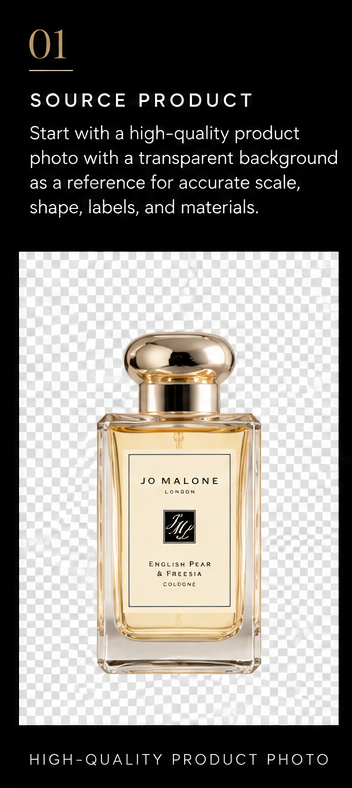
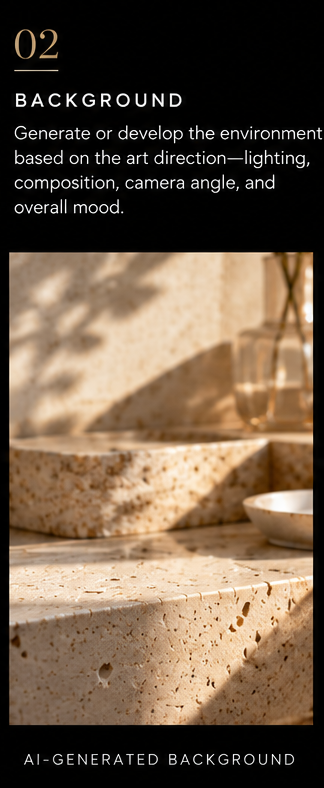
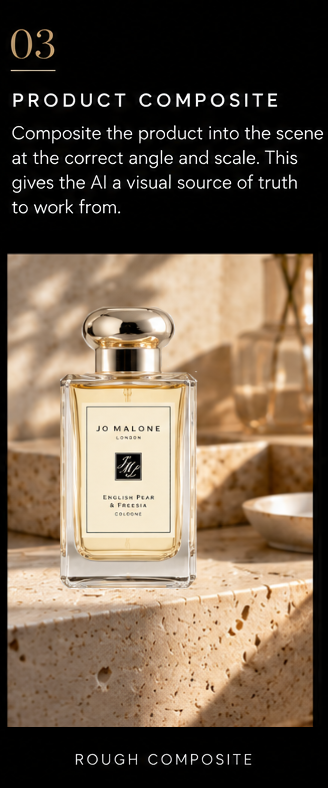
I first created a source product with a transparent background. Next, I generated the empty background environment from the art direction: lighting, composition, camera angle, surface, and overall mood. Once the background was approved, I slapped the product on top of the background.
That rough composite became the input for AI refinement.
The model no longer had to invent what the product looked like. It had a visual source of truth and could concentrate on integrating it into the environment through lighting, reflections, contact shadows, perspective, and material interaction.
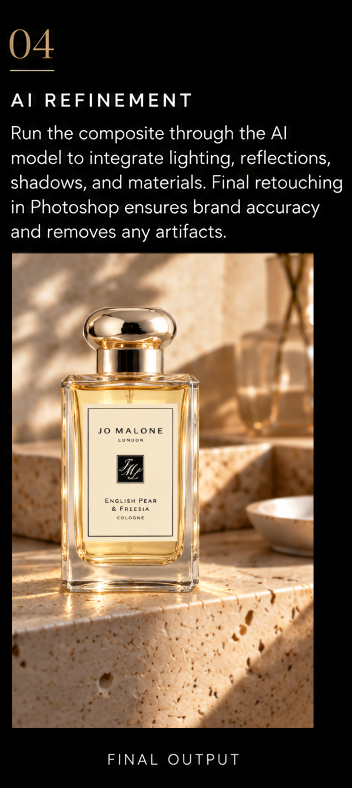
03 — Why It Worked
Giving the model a concrete visual reference dramatically improved consistency compared with text-only generation. Products retained more accurate proportions, recognizable packaging, and closer material behavior while still benefiting from generative lighting and environmental integration.
Photoshop remained an important final step for correcting labels, product geometry, reflections, and other details that AI could not reliably preserve.
Better product fidelity
Better output for alternative versions
Fewer hallucinations
Faster art-direction iteration
04 — Making the Workflow Accessible
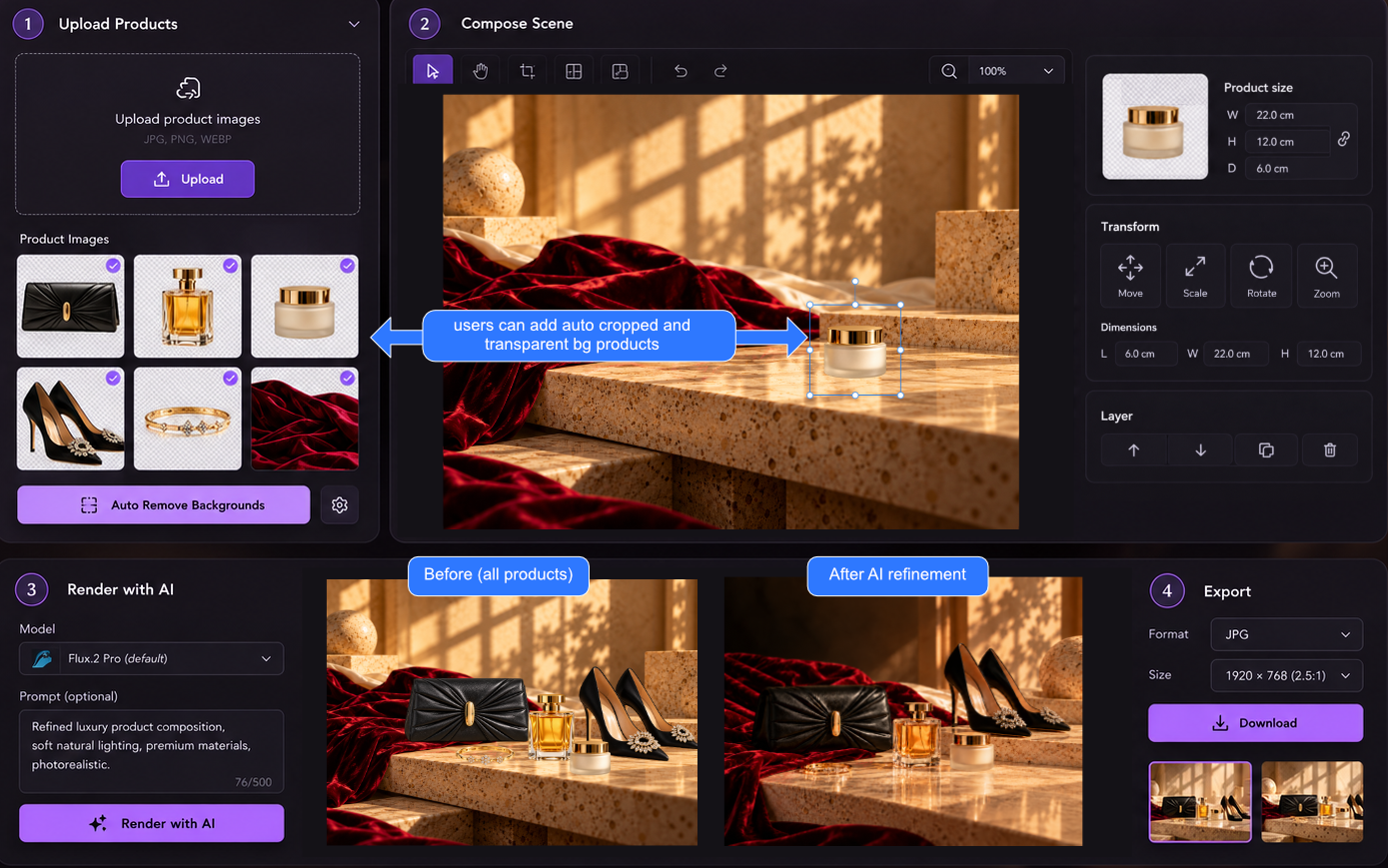
Once the workflow of slap-comp proved reliable, I built a lightweight prototype tool using Kiro that allowed teammates to assemble these reference composites without Photoshop or Figma.
Users could place an empty background into a scene, import product, automatically create white backgrounds and crop to pixel, change product size to be accurate to real scale, adjust composition, crop for required formats, and export production-ready inputs for generative refinement.
The goal was not simply to improve my own output, it was to make the process repeatable for the broader creative team who didn’t have access to tools we did.
Worked best for: hard surface items, accessories, footwear, and larger product forms
Hardest category: fine jewelry, on-model soft items, and low-pixel-detail referencesBelow: Workflow reconstruction - original internal tool unavailable after departure.
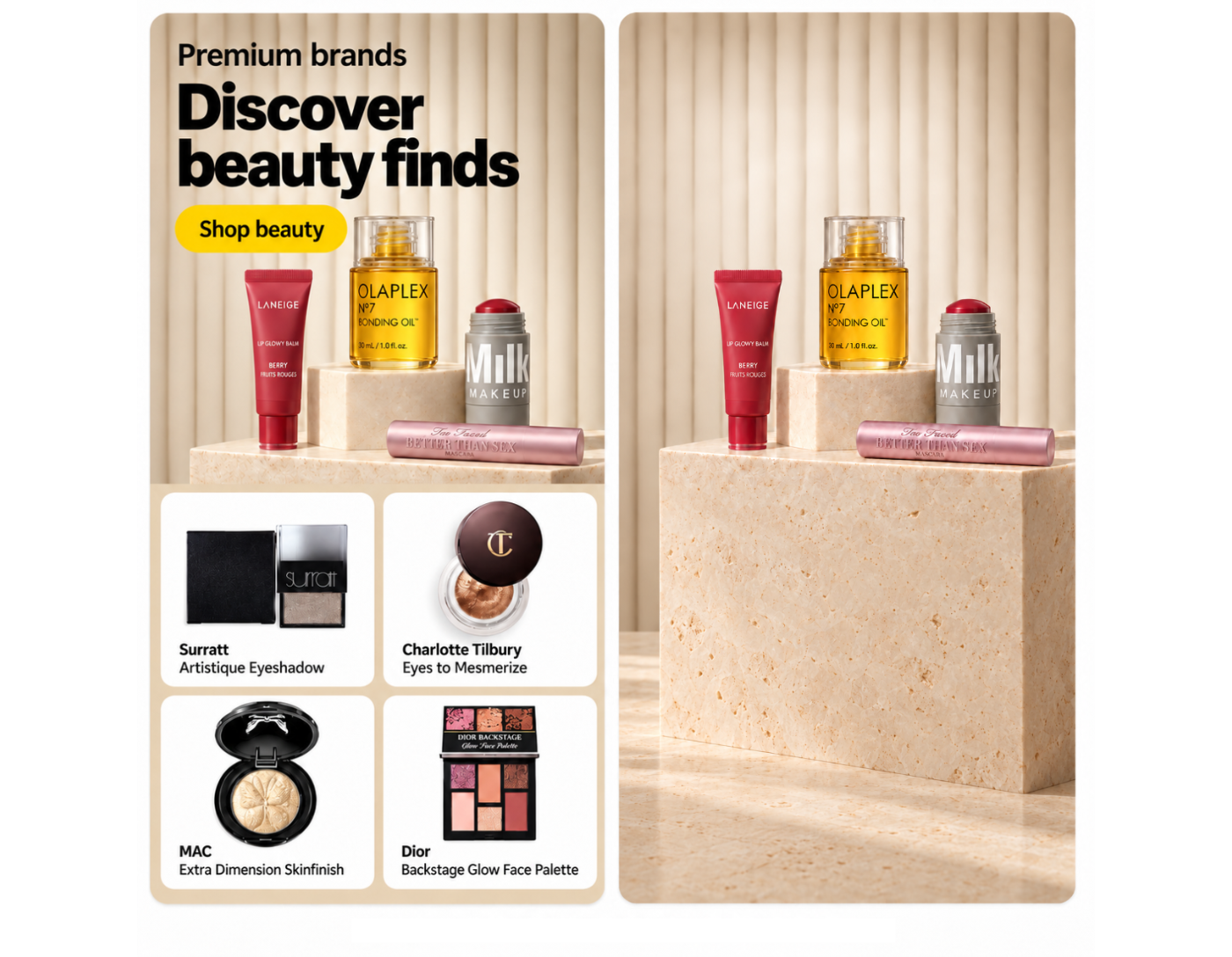
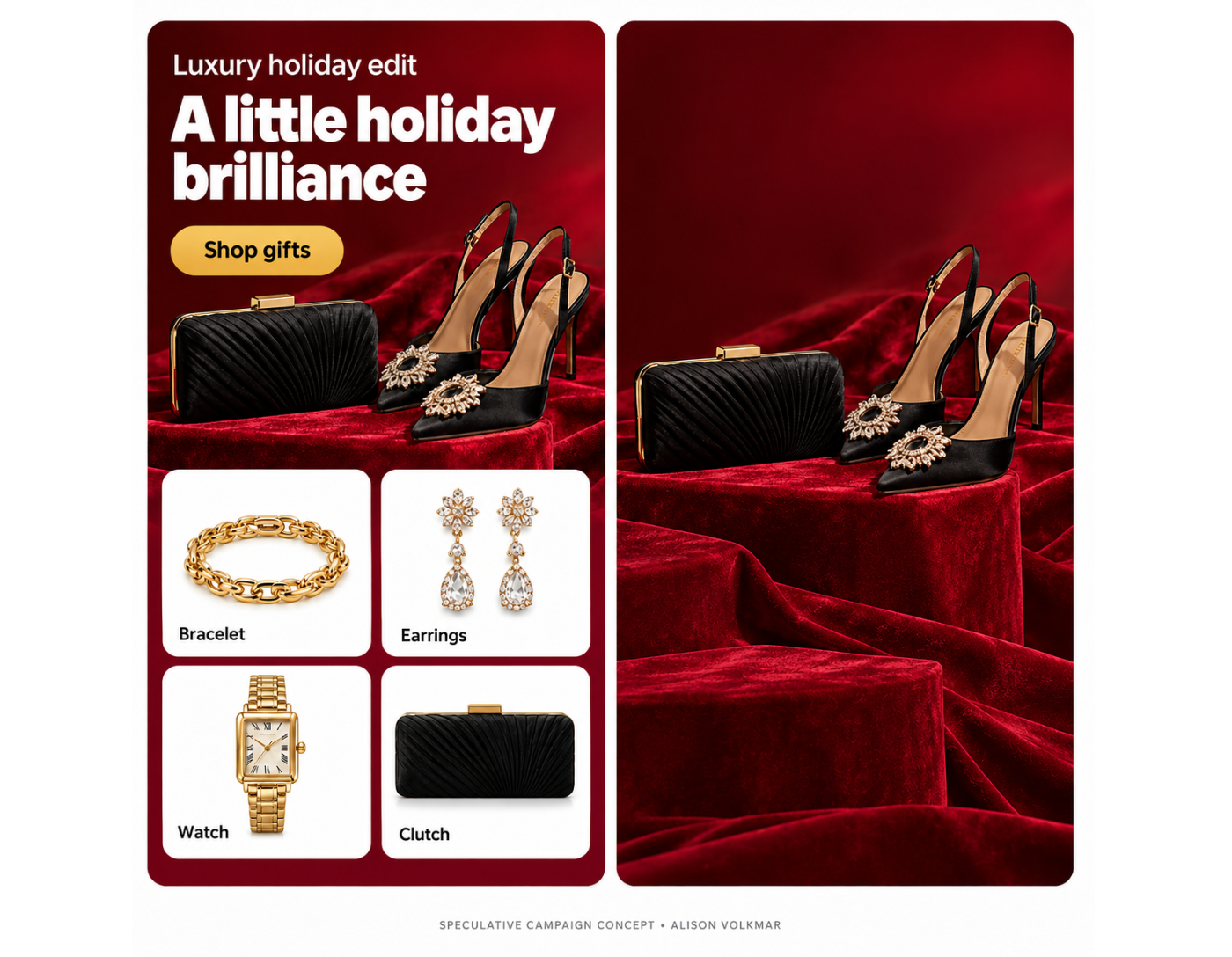
Work examples
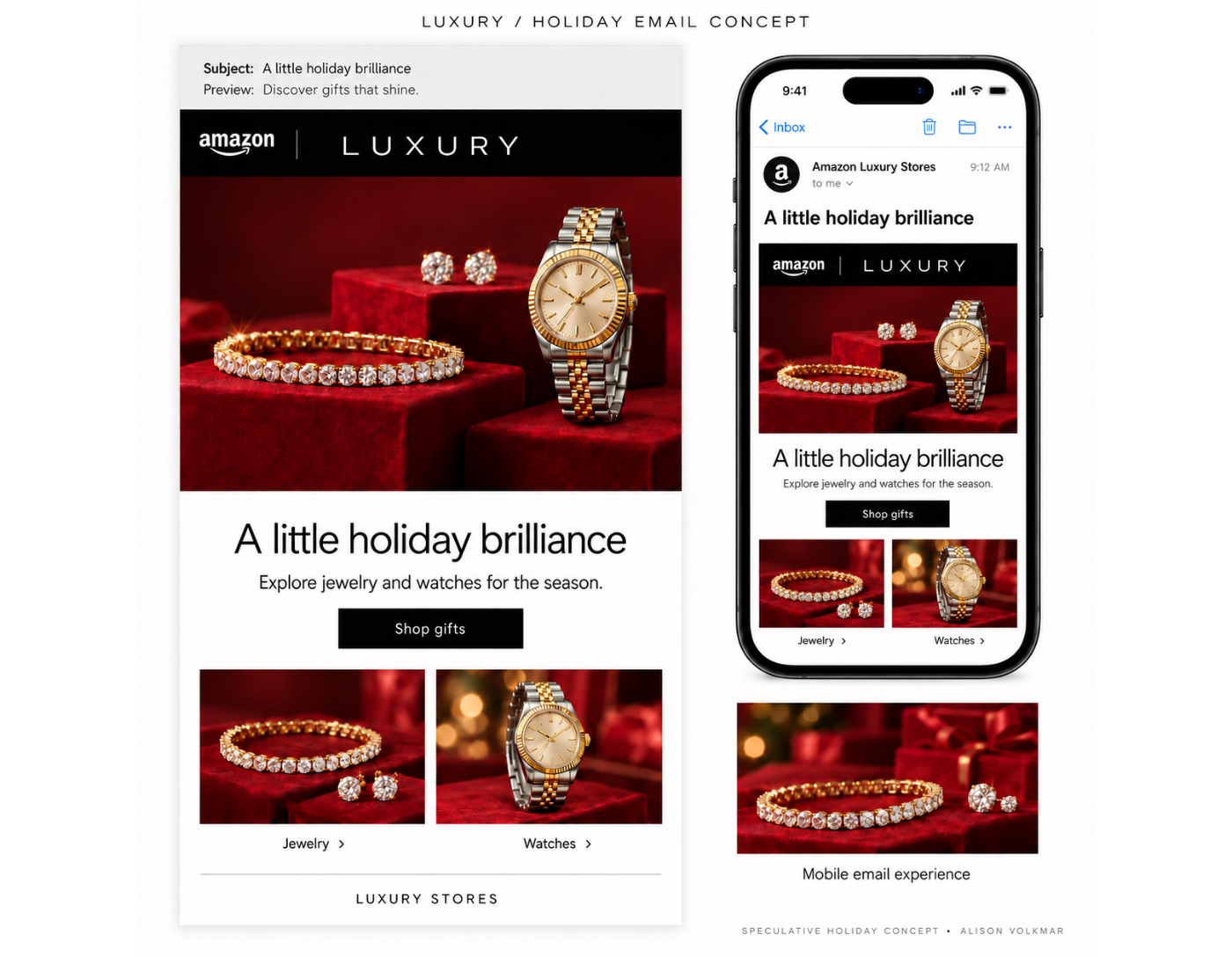
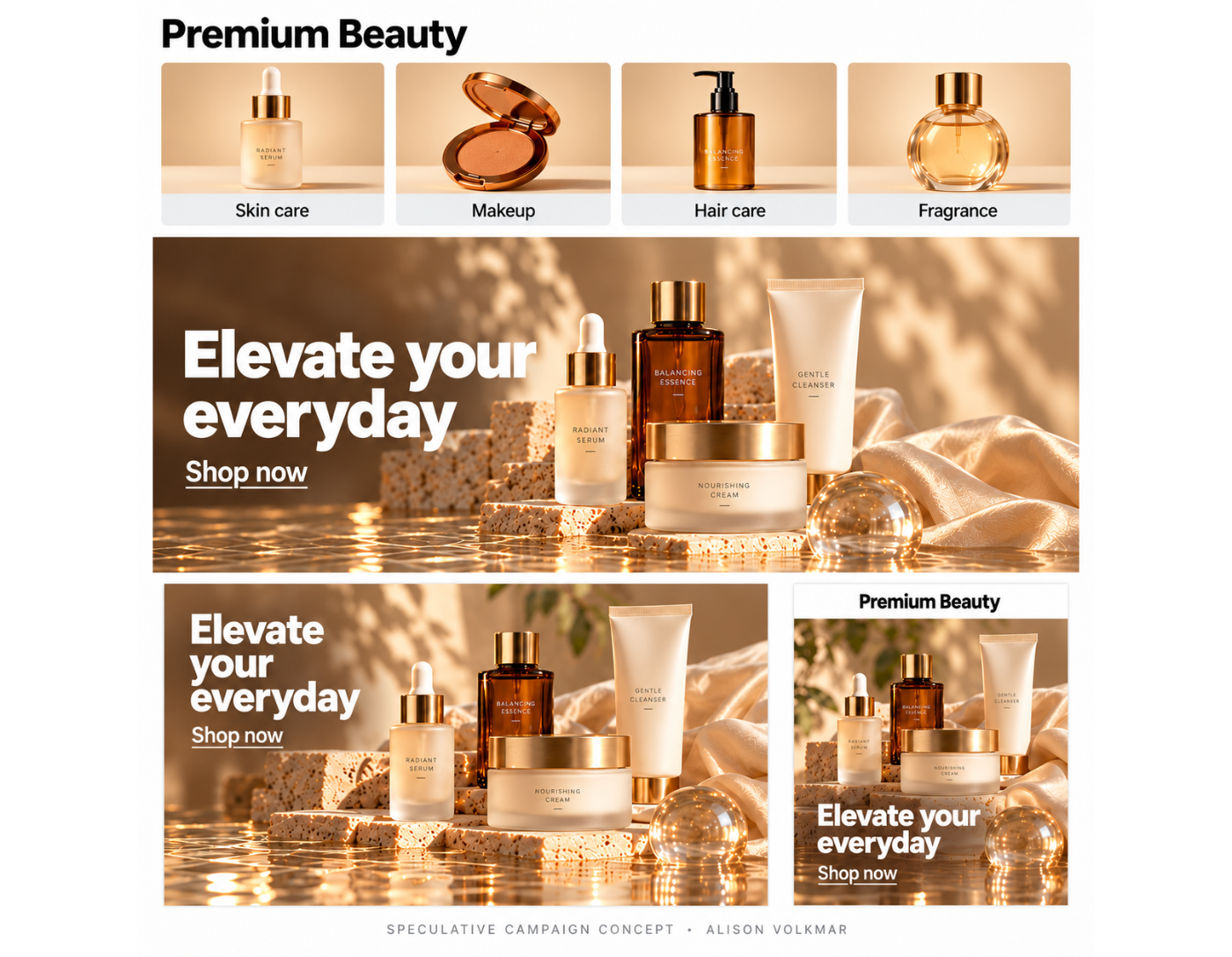
Amazon Luxury Videos (Spec Work)