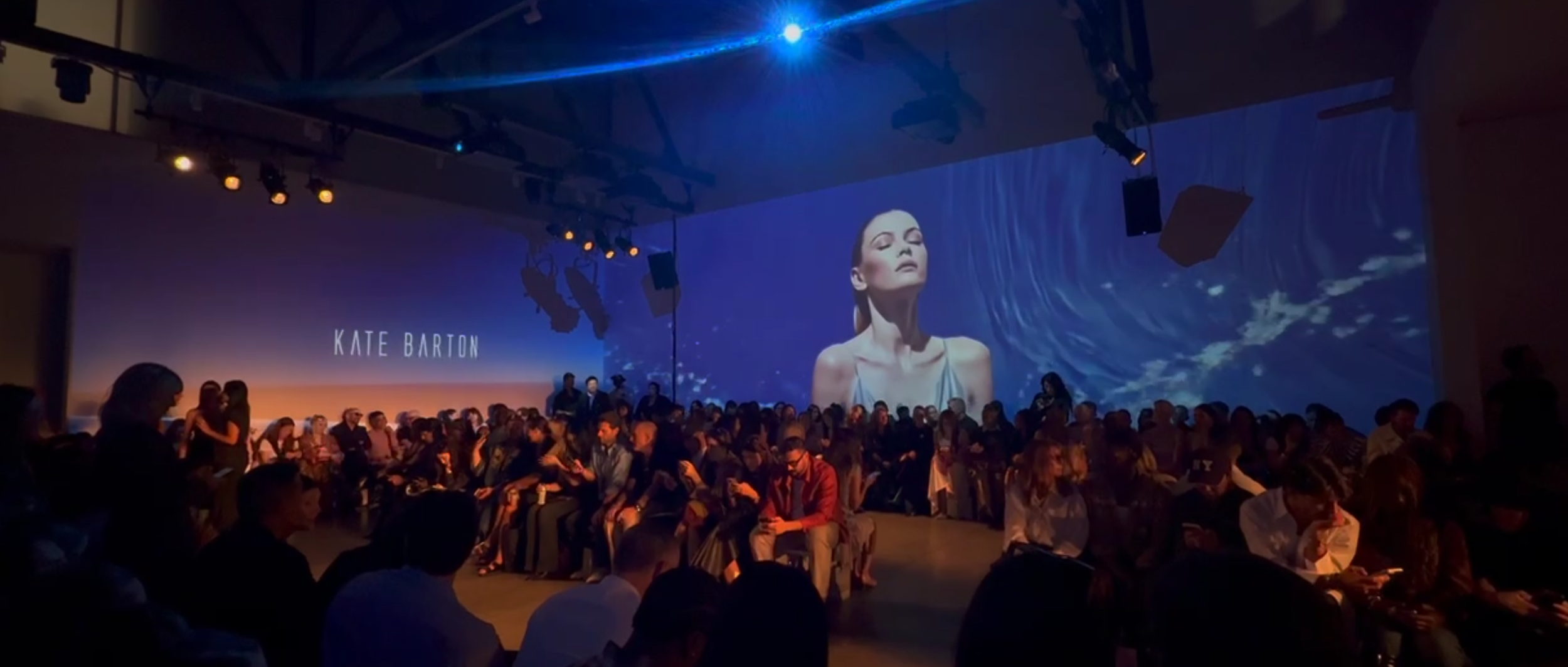
KATE BARTON x AMAZON LUXURY
Generative fashion film, image continuity, and visual development for Kate Barton’s NYC fashion showcase
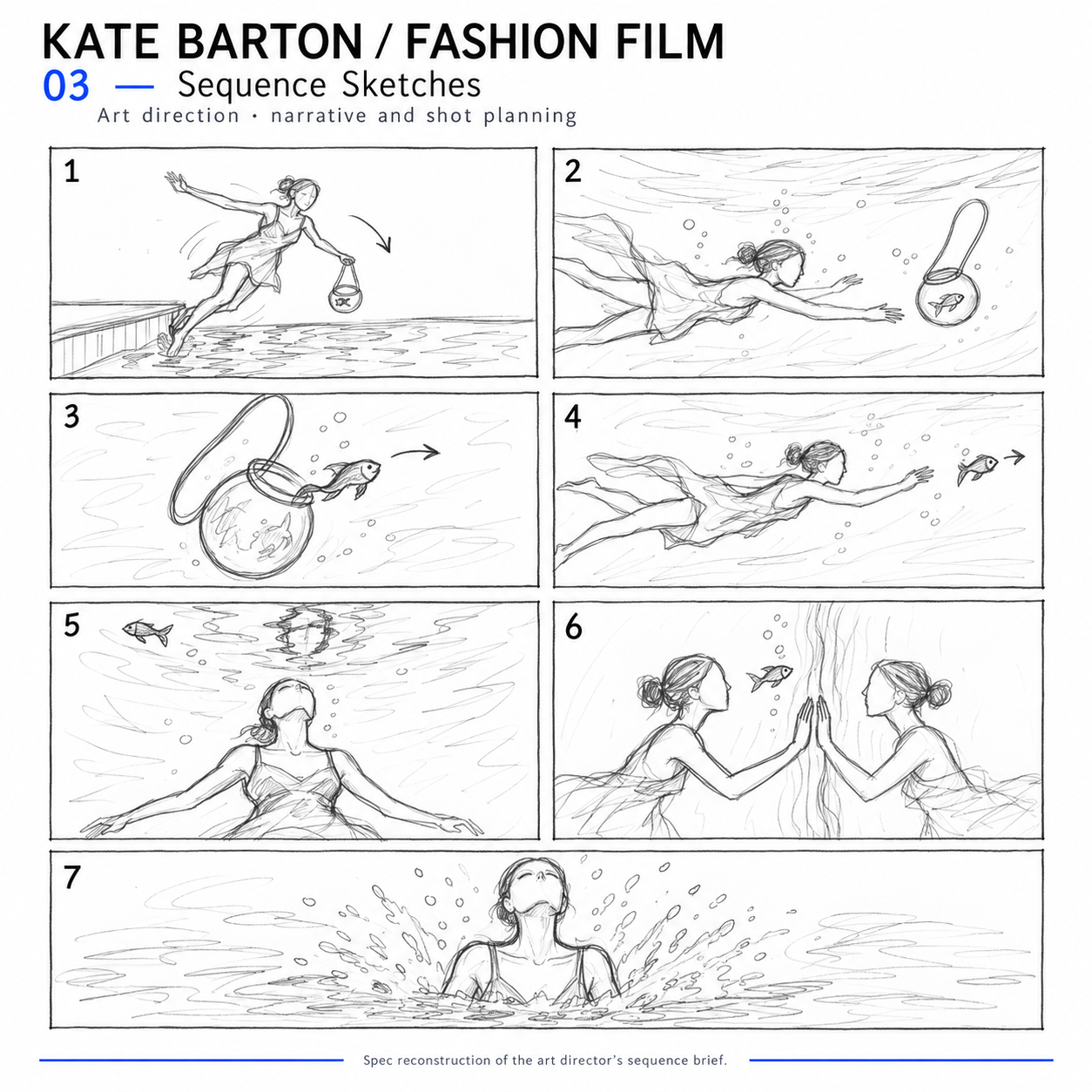
Using Figma for real-time team collaboration, I worked alongside the Art Director to provide Photoshop for retouching, and generative AI tools for image development. I refined scenes to match the original model and maintain visual continuity. Multi-angle model references and product imagery guided the process, preserving the Peyton Mini Dress’s metallic fabric, sculptural hardware, and fishbowl accessory from concept to final frames. I then translated the frames to video via GenAI.
Role:
Visual development, continuity retouching, frame planning, video generation, AI model R&D
Tools:
Figma, Photoshop, After Effects, FAL.AI (Kling, Seedance)
Project Challenge
The biggest challenge was maintaining consistency across the model, garment, accessory, and generated motion with extremely limited source material.
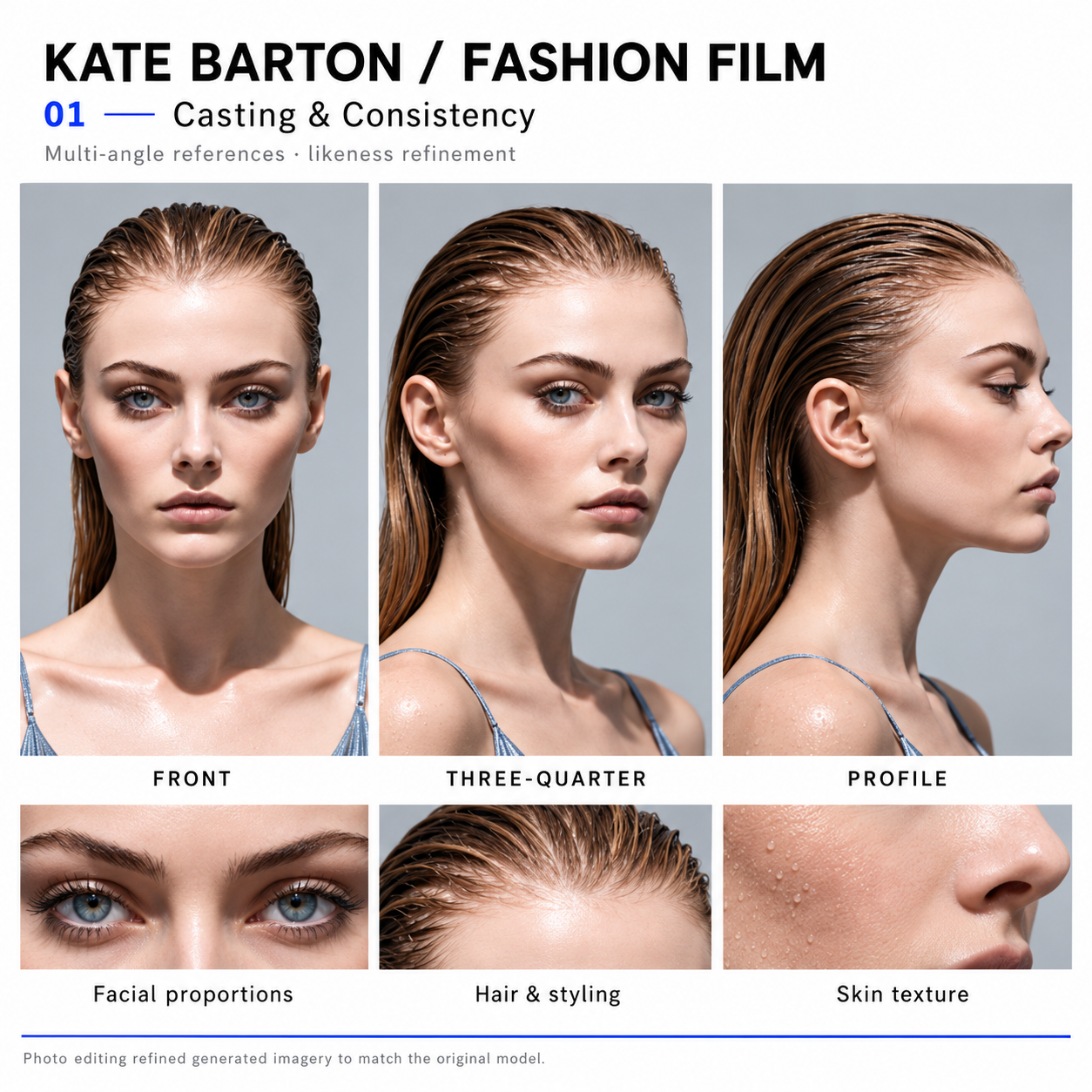
Kate Barton provided a small set of model inspiration references selected with the art director, including front and side views of the original human reference. From those, we needed to create a new, inspired digital model that could remain recognizable across multiple angles and scenes.
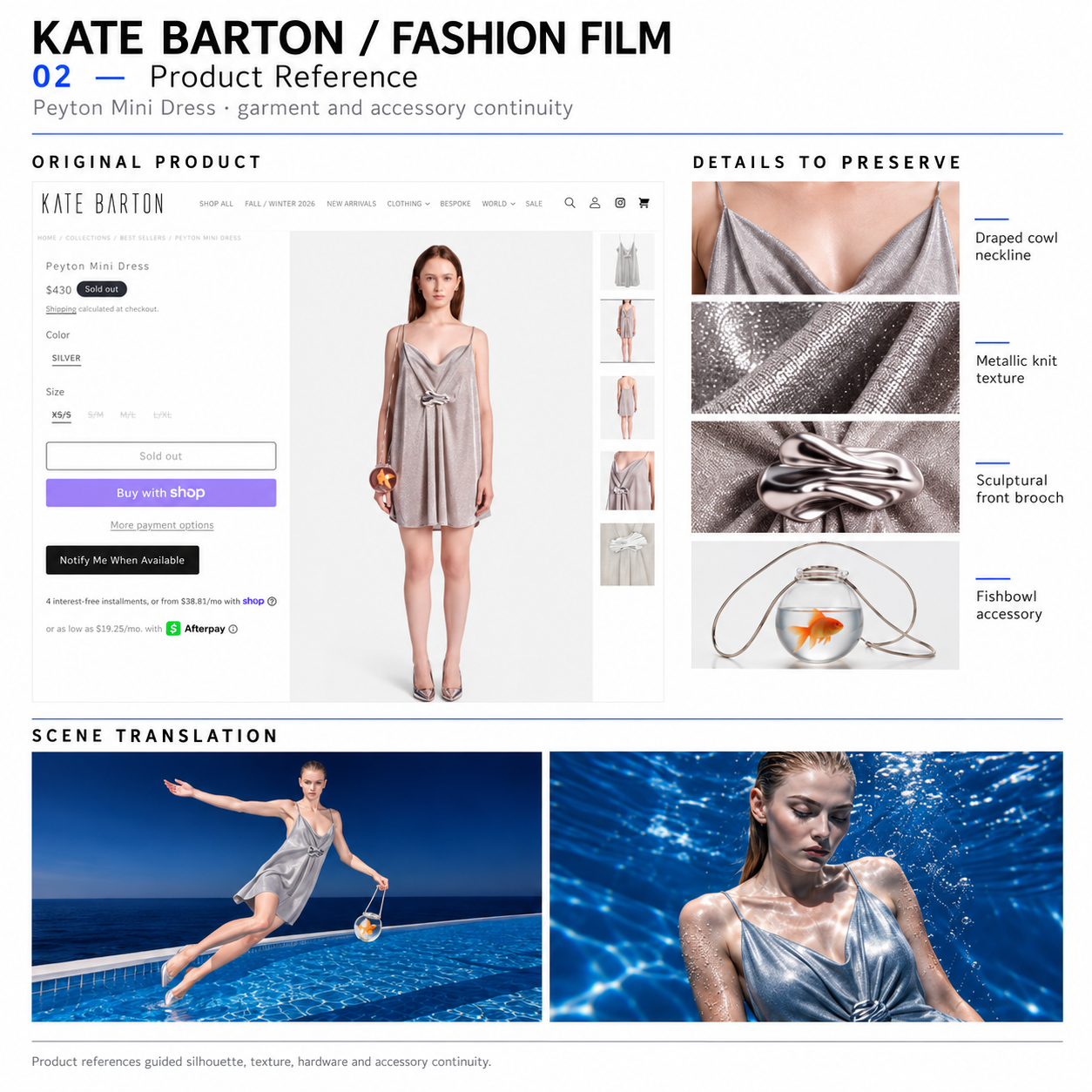
The garment presented a similar problem. We only had front and back product imagery, with no side views, physical sample, or meaningful dimensional measurements. Key details such as the sculptural brooch, metallic fabric, and fishbowl chain also proved difficult for generative models to preserve consistently.
At the time, AI video models were especially prone to visual drift and hallucination. Fabric would become overly fluid, the fishbowl could transform into an actual fish, facial proportions would shift, and motion-heavy sequences (such as the model falling into the pool) often broke down entirely.
Approach
I created a reference-driven workflow designed to reduce that instability.
Using the approved model inspiration, I generated additional angles and then manually retouched them in Photoshop to keep the character consistent across hairline, body structure, eye shape, lips, and overall proportions. These images became the basis for the LoRA and an approved model reference sheet used throughout production.
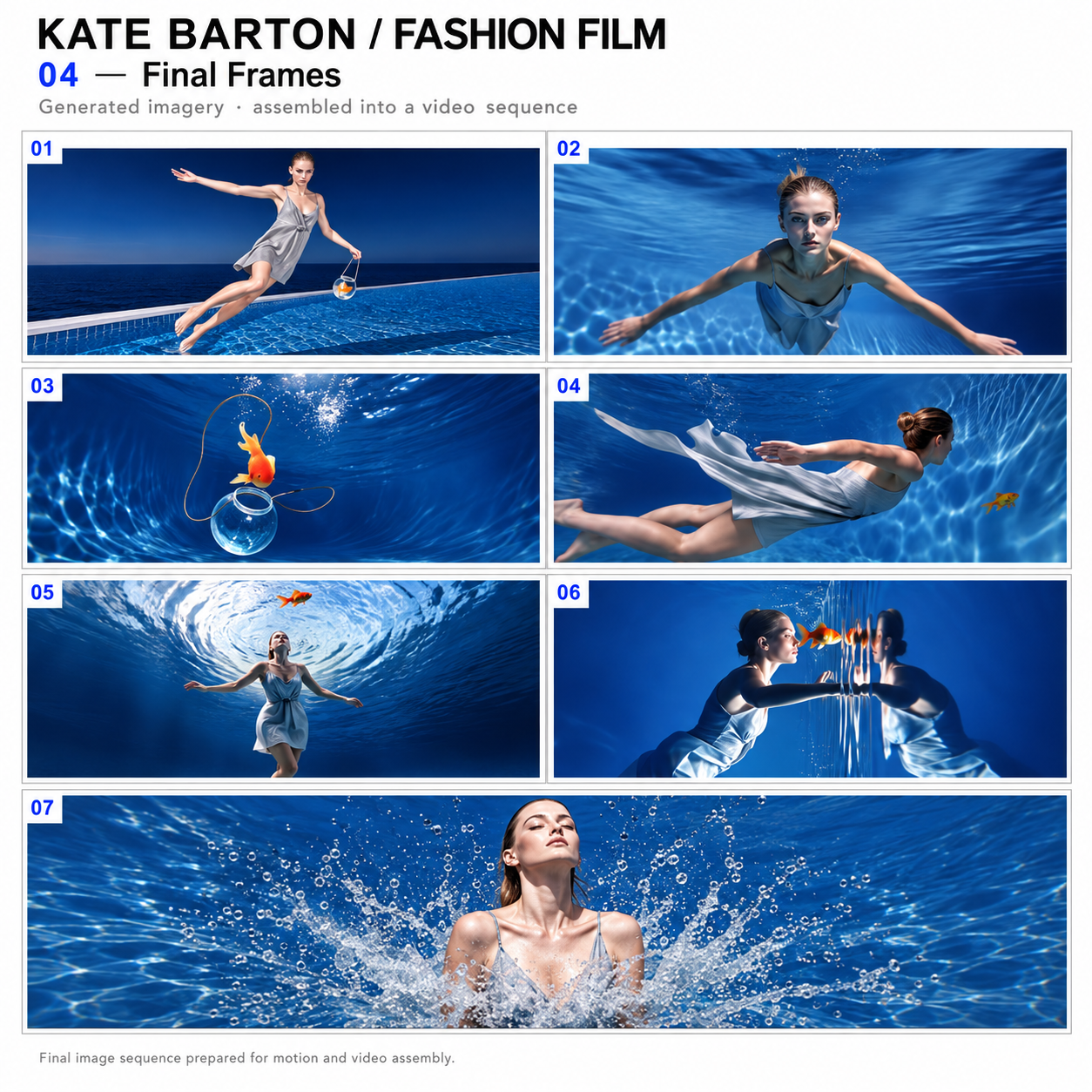
For the garment and accessories, I reconstructed missing visual information from the limited references and repeatedly corrected generated frames in Photoshop. Every video sequence began with manually refined first and last frames to anchor the model, garment, and accessory structure before video generation.
The working loop became:
Generate → Compare → Retouch → Re-reference → Regenerate
Figma boards were used to collect the strongest frames, gather art director feedback, and track revisions across the team.
Why the First / Last Frame Workflow Mattered
Most of the team initially relied heavily on text prompting, but detailed prompts often introduced new errors rather than solving existing ones.
I began using carefully prepared first and last frames earlier in the process to give the video model stronger visual constraints. While the output was never completely controllable, this approach produced the most reliable continuity and helped reduce hallucination during motion generation.
A large number of sequences were rejected and regenerated, especially shots involving complex body movement. Ultimately, three of my generated video shots were selected for the final film.
Outcome
The final film maintained a recognizable model, garment, and accessory system across a series of AI-generated scenes despite the limited source imagery and technical limitations of the tools available at the time.
The finished video was shown as part of Kate Barton’s fashion presentation and was later adapted into a shortened, faster edit for the Amazon Luxury storefront homepage.